
I Spent Thousands of Dollars in Ads, and I Learned ONE Important Thing
In my own eCommerce company selling office workspace products, I learned a valuable lesson after spending a couple thousand dollars a month running ads. What I thought would work ended up giving me mediocre results, but during this experiment, I learned something that's worth so much more...
7/3/20263 min read

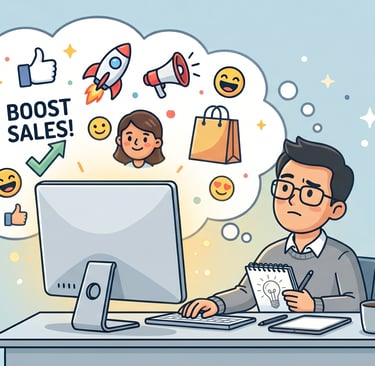
Before I was advising other companies on product strategy, I ran my own eCommerce business selling office workspace products — desks, organizers, ergonomic accessories, the kind of gear people buy to make their home or office setup actually work. My flagship product was priced north of $150, which meant every ad dollar had to work hard to earn a real conversion, not just a click.
Like a lot of founders, I started with a hypothesis about where my customers were. I assumed LinkedIn made sense — my buyers were professionals furnishing home offices, so shouldn't I find them where they talk shop? I also tested Facebook, betting that strong product photography and lifestyle targeting would do the job. I spent a couple thousand dollars a month running both, watching the numbers, and adjusting.
They didn't work. Not because the ads were bad, and not because the audience wasn't technically "right" on paper. They didn't work because of intent.
The lesson: intent beats targeting
On LinkedIn and Facebook, I was interrupting people. They were scrolling, networking, catching up with friends — nobody opens LinkedIn thinking "today's the day I buy a $150 desk organizer." I was asking people to go from zero interest to a considered purchase in the space of a scroll-stopping ad. For a product under $20, that impulse gap is small enough to close. For a $150+ item, it's a canyon.
Google was different, and the difference wasn't the platform — it was the moment. Someone searching "best standing desk converter for small office" or "ergonomic keyboard tray for home office" had already done the hard part themselves. They'd identified a problem and started looking for a solution. My ad wasn't interrupting them; it was answering a question they were already asking. That's a completely different psychological starting point, and it showed up immediately in conversion rate. The cost per click on Google was sometimes higher than Facebook, but the cost per sale was dramatically lower, because I wasn't paying to manufacture demand — I was paying to meet demand that already existed.
Why this matters more than "pick the right channel"
It would be easy to read this and conclude "just use Google Ads for eCommerce." That's not really the lesson, and it's not the one I want to leave you with. The real lesson is that my assumption about where my customers were was wrong, and I only found that out by running the experiment.
I thought LinkedIn made sense. It had a clean, professional logic to it. But a clean logic isn't the same as a validated one. If I'd trusted my instinct and poured the whole budget into LinkedIn because "that's where my buyers hang out," I'd have burned through a limited ad budget chasing a channel that was never going to convert for a considered, higher-ticket purchase.
With a limited budget, the instinct is often to conserve it — pick the channel that feels safest and commit. In practice, the better use of a limited budget is the opposite: spread small, controlled tests across a few channels early, let the data tell you where intent actually lives for your specific product and price point, and then concentrate spend where it's working. The few hundred dollars I "wasted" learning that LinkedIn wasn't going to convert was some of the best money I spent — it told me where not to keep spending.
The takeaway for founders and product teams
This is really a product problem disguised as a marketing problem. Any time you're deciding where to put a limited budget — ad spend, engineering time, a new feature — the question isn't "what feels like it should work." It's "what have we actually tested, and what did the data say." Assumptions are a starting hypothesis, not a strategy. The companies that get this right build in small, cheap experiments before they commit real money, and they're willing to be wrong about their own instincts when the numbers say so.
If you're running paid acquisition on a tight budget right now, my advice is simple: don't skip the experiment phase to save money. The experiment is what saves you money.
Share Your Pain Points & Let's Chat!
© 2026. All rights reserved.